The DSK case and the Sisterhood

Although I have always called myself a feminist, I was, in the days following Dominique Strauss-Kahn’s arrest, unable to join the sisterhood in condemning a man — albeit of dubious moral record — for the crime of attempted rape before he had actually been found guilty.

Having written a piece (that was never published) attempting to explain the French outrage at the “perp walk” and public shaming of someone theoretically innocent until proven guilty, I ducked the flak and watched the case unfold in silent bafflement that my own views could be so at variance with those of my fellow female journalists in Britain and America.

Have I gone native, I wondered? Have I been corrupted by French libertinism?

I would not describe myself as a libertine.* I believe in the wisdom of monogamy for optimal happiness and I think that transparency in a relationship is a desirable goal. I do not, however, underestimate the difficulty of marriage and I refuse to judge others for a failure to live up to the above standards.

I also accept the notion that it is possible to be happy in what used to be called “an open marriage,” and although that would not be my choice, I refuse to judge others if it is theirs.

Knowing, as I did, Strauss-Kahn’s reputation as a sexual predator and philanderer, I was not drawn to the man, even before he went to America and I doubt that I would have voted for him, but I still felt queasy at the sight of those shaming placards outside the courtroom on the day of his release, or of the abusive cry of: “DSK, you’re a sick bastard and your wife is even sicker.”

Clearly I have little stomach for the witch-hunt because I was also shocked by a column in Britain’s Daily Telegraph that attacked even Strauss-Kahn’s long-suffering wife, Anne Sinclair, for her decision to stand by her husband. Allison Pearson’s tirade was entitled “When forgiveness goes a step too far.”

“Forgiveness is good,” writes Pearson. “Even so, the nauseating sight of French heiress and journalist Anne Sinclair standing by her man, Dominique Strauss-Kahn, sets a new low. The former IMF chief may have been acquitted of attempted rape against a hotel maid, but is there anyone who can look at that swaggering silverback primate without a shudder? Ugh … Shame on his indulgent wife.”

Why is it that this woman feels she has the right to condemn this couple in this way? What is it about our culture that makes us so quick to judge, and so quick to blame? Are we all so blameless ourselves that we can be so censorious when our public figures slip from the path of moral rectitude?

I believe that the answer lies in our Protestant heritage. The Catholic practice of confession allowed for sin as an inevitable part of being human. In abolishing the privacy of the confessional and in making the congregation the only moral arbiter outside that of our own conscience, we paved the way for a society in which the media has replaced the congregation in an endless pursuit of moral voyeurism.

No one in France underestimates the horror of the crime of rape. Agnes Poirier — a French journalist based in London whose thankless task it has become to explain her contrary nation to the rest of the world — points out that “It is the shift (from ardor) towards coercion that makes the sex act a public matter. If it is between two consenting adults, it remains a private act.”

She bravely goes on to suggest that cheating on your wife does not automatically make you incapable of doing your job, adding, “but I know that this argument is impossible for most Americans and British to understand.”

Why impossible? Surely we can all agree that sex is a complicated business, that one man or woman’s ecstasy is another’s nightmare and that judging others carries the very real risk of being judged ourselves.

Surely this case proves how dangerous these trials by media are? We all thought we had the perfect victim in Nafissatou Diallo. She was poor, black and female. Strauss-Kahn was rich, white and male. It was a no-brainer. And yet here we are with a woman sufficiently dishonest for the case to have been dismissed by a district attorney whose interest it was to see a prosecution.

As French writer and commentator, Elisabeth Levy points out in ‘Causeur‘, we do not know what happened between those two people in that hotel room. And D.A. Cyrus Vance was brave enough to admit that, even at the risk of ruining his chances of re-election.

Levy goes on to condemn the fuzzy logic that Strauss-Kahn must have raped Diallo because he publicly confessed to cheating on his wife. “In other words,” writes Levy, “all adulterous men are rapists. I imagine, dear male readers that some of you may be starting to feel a little uneasy …”

Levy is what I would call an old guard feminist who, like me, laments the battles that now being fought in the name of equality.

For the Strauss-Kahn case has uncovered the divide, not between men and women so much as between old and new feminists. Old feminists, from Genevieve Clark to Erica Jong, believed that the goal was political and sexual freedom for women, not the political and sexual subordination of men.

I cannot accept the idea that womanhood automatically implies victimhood, nor do I think that it is a desirable state of affairs when women see men as the enemy.

The man-hating tirades of my female colleagues are nothing but puritanism in disguise and I suspect that our feminist forebears would be dismayed by the climate of inquisition that seems to dominate relations between men and women today.

* Significantly, there are 2 definitions of the word Libertine. In English we tend to forget the second in favour of the first.

1 a person, esp. a man, who behaves without moral principles or a sense of responsibility, esp. in sexual matters.

2 a person who rejects accepted opinions in matters of religion; a freethinker.

A version of this post appeared on http://www.cnn.com

Pour un article en francais sur l’affaire DSK voir Le Courrier International du 01.09.2011

DSK


Why do so many French women – and not just powerful women in politics and the media  – see DSK as the victim?

Listening to the French equivalent of BBC Radio 4 this morning (France Inter) brought it home to me: France is one of the last great patriarchies. I could hardly believe my ears. There, in the recording studio, a female journalist called Pascale Clark sat tittering at male comedian, Sami Ameziane, who was impersonating DSK in his hotel room in New York trying to talk some sense into his penis: “Listen I don’t like the look of this chick, she’s going to get you into trouble, put away the merguez, buddy…” But it’s the other voice that wins: “Come on Dom. Have you forgotten who you are, Dominique-nique-nique-nique*. Whip out the tools, mate…”  The three minute sketch was a festival of macho inanity the subtext of which was, either the maid was asking for it and changed her mind half way through, or it was a set-up. In both scenarios DSK is the ‘vigorous’ male (as Christine Boutin described him), a Samson figure, being brought low by a woman.

When Segolene Royal ran for the presidency, I was stunned by the misogynistic comments, from both men and women, that polluted her campaign. When she failed to get elected I wondered if it was what the French call a strategie d’echec, her own unconscious urge to fail, because she was not ready to question her own conditioning. Today, the widespread view of DSK as a victim confirms my misgivings. Willfully unreconstructed, France is a society in which women collude in a continued phallocracy.

If Brits and Americans want to understand this mindset all they have to do is watch Joan Holloway, the curvacious redhead in Madmen, a TV series set in an advertising agency in 1960s America. Joanie is clever, sexy, witty and submissive. She’s admired, valued, often worshipped and always dominated. This is the unspoken pact most French women are still willing to accept.

*nique : screw


DSKNY

When I first heard the news of Dominique Strauss Kahn’s arrest in New York I clapped my hand over my mouth in horror. The news was shocking in itself – attempted rape…unlawful imprisonment – but my alarm went deeper than the accusation itself. It felt like a kind of reckoning, a death knell to a certain idea of France. Suddenly, DSK, the Grand Seducteur, the infamous lover of women was revealed as nothing more than a dirty old man unable to control himself. In the process, the very French mythology surrounding sex – particularly of the extra-marital kind – as a private, elegant and decorous game, was exposed as a big lie serving, primarily, as a rampart for the patriarchy. How fitting it was that the nemesis (both of the man and the myth) should be played out in America, the home of the witch-hunt and the cradle of political correctness. And how predictable that so much of the reaction to this story has centred, on both sides of the Atlantic, upon a visceral clash between two world-views.

On the morning after DSK’s arrest, words like “Incredible”, “unbelievable” “Inconceivable” peppered the French headlines. America was universally outraged by the details of the case while in France Twitter was awash with conspiracy theories exonerating the politician. DSK’s socialist colleagues all leapt to his defence. Former prime minister, Laurent Fabius (“in shock”) spared a thought, not for the supposed victim, but for Strauss Kahn’s wife and family. Even his political opponents alluded to a possible set-up by Sarkozy’s entourage to undermine his candidacy for the presidential elections. Former minister for housing, Christine Boutin, in the manner of a true courtesan and guardian of the patriarchy said, “To me the whole business seems highly implausible! We know that he’s rather vigorous, if you know what I mean, but that he should get himself caught like that, seems unbelievable so I hope he’s just fallen into a trap.” The general state of shock in France, then, is not so much that the alleged crime should have taken place but that DSK allowed himself to get caught.

My friend, the journalist and writer, Michele Fitoussi, feels that what’s happening to DSK is being lived out as a national trauma. “We had all heard about him, some made jokes and some knew what he was capable of. For years during our Parisian dinners we’d sit around slyly alluding to DSK’s dubious behaviour with women. We made jokes about the fact that a sexily dressed woman shouldn’t be left alone with him. There were rumours that it went further than the occasional visit to Les Chandelles (Paris’ most elegant swinger’s club). There’s a climate of maximum tolerance towards our male politicians that we’re just waking up from. It feels like a real collective trauma.”

But will this trauma cause a change in behaviour? Not necessarily. French reaction – male and female, public and private – to what is widely seen as the ritual and unnecessary shaming of DSK, betrays the entrenchment of patriarchal values, still being disguised as Epicureanism or savoir vivre. Listen to Bernard Henri Levy’s priceless response on French national radio: “Do you think for one second that we would be friends if I thought that DSK was a compulsive rapist (love the use of the word compulsive here), a Neanderthal man, a guy who behaves towards the women he meets, like a sexual predator? All this is utterly grotesque.”

Significantly, BHL ends the interview by stating that not everyone is the same: “Everybody is not everybody! The President of the IMF, the man who was about to be a candidate for the presidency of the French Republic, handcuffed! It’s obvious that he’s not some commoner (quidam). This American justice is an outrageous hypocrisy (Tartufferie), something I already knew but which today is blindingly obvious to me.”

BHL, with his humanitarian posturing and his patrician lecturing, is the living embodiment of the endless struggle that lies at the heart of French culture, between the myth of Republican equality and the hierarchical values of the Ancien Regime.

Banning the Burqa

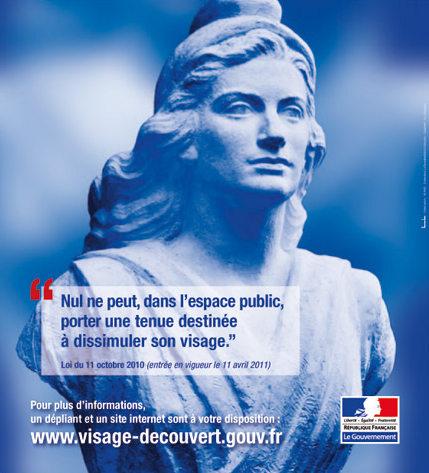
French Government Campaign

This month, a bill making the wearing of the burqa* illegal in public will become law in France. Predictably, as an Englishwoman I have mixed feelings about this law. On the one hand I agree with Sarkozy’s former minister, Fadela Amara, who like the majority of her fellow French Muslims, objects to the burqa as a symbol of religious extremism and patriarchal oppression. On the other, I believe that laws targeting religious practices ought only to be considered if they represent a threat to individual or public safety. My first instinct in moments such as these is to ask my French-born children what they think. My 23 year-old daughter sees me coming. “My opinion,” she begins. “Is quite radical. And quite French. When I see a woman walking down the street in a full veil I immediately picture the husband who is making her wear it.” My daughter approves of the ban because behind the burqa she sees a life of ostracism and male domination. My son is also for the ban and his argument runs like this: the form of Islam that suggests that a woman’s face must be covered in order to preserve her decency is inferring that women are intrinsically indecent, an idea that is not only appalling but contrary to the values of French society. I can understand both these positions. The trouble is, I’m deeply suspicious of the motives behind this law and this colours my view, not only of its justice but of its efficacy.

Unlike the law of 2004, which banned the Islamic headscarf (hijab) in French state schools, the wording of this new law against the burqa is deceptively simple. “No one may, in a public place, wear a garment designed to conceal the face.” No mention this time of religion, or values, or of that sacred cow, la laicite. The government campaign surrounding the ban is purposefully ambiguous and designed to suggest that this is not so much about Islam or French identity as it is about some undefined form of practicality. The campaign slogan, “La République se vit à visage découvert” can only be loosely translated into English as, “We live the Republic with our faces uncovered/without a mask.” It is not surprising in this context that a list of exemptions to the law are being drawn up and will include motorcycle couriers, carnival revellers and people with bird flu. (One cannot help wondering about cases like Lady Gaga.)

Unfortunately, however, recent events suggest that this is a law about Islam and a further example of the rather ugly finger pointing that has been going on since the beginning of Sarkozy’s presidency. In the months since the President first announced, during his somewhat overblown performance at Versailles in June 2009, that “the burqa is not welcome in France”, he and his party have adopted a discernible strategy of political harassment of the Muslim community, all of it designed to win votes from the extreme right. After launching, in November last year, a public debate on the rather nebulous question of French national identity, Sarkozy cut to the chase in February this year and announced a new, even meatier debate on the place of Islam in France. Strong in the knowledge that 42% of French people now believe Islam to represent a threat to the nation and knowing that the burqa is worn by only a tiny fraction of France’s Muslims (about 2000 women), Sarkozy clearly believed he could use this law to whip up yet another wave of anti-Muslim sentiment without getting burned. It now appears he was wrong. In seeking to occupy and thereby legitimising the ideological ground of the extreme right he now finds himself neck and neck with Marine Le Pen in voting predictions for the next Presidential elections. Alarmingly, a recent poll foresees the head of the National Front knocking him out in the first round. Sarkozy’s strategy, then, to gather a consensus around the febrile issue of French identity, has worked but in the process he has shot himself in the foot.

The place of Islam in France will doubtless lie at the heart of the next elections but fermenting mistrust towards her Muslims is unlikely to result in their jubilant desire to throw off the veil and live the republic to the full.

*understood in France as the full veil (niqāb) covering the face.

NB A version of this post appears in this month’s Prospect Magazine (Online)

Bad Politics

Racial prejudice in France, each time it manifests, is generally expressed under guise of secularism or laïcité. We’ve got nothing against Muslims – runs the argument, which can come from the left or the right – we just don’t believe that religion has a place in the identity of the French nation.

The public debate launched by Nicolas Sarkozy on November 2nd last year on the subject of ‘L’Identite Nationale’ was a misguided manoeuvre designed, at least in part, to purloin votes from the far right. It backfired, of course, mainly because there is a structural paradox inherent in French culture that makes it impossible to have a measured debate on this issue. Frenchness, since the Revolution, is supposed to be rooted in the so-called universal values of The Enlightenment, which include such vaguaries as the individual before the state, reason before custom. The result is that for most French people Frenchness can only really be defined by its opposite: i.e. being French means not being English or worse, American, or even worse, Romany or Muslim.

With this in mind it is not hard to understand why a recent poll attempting to assess attitudes towards Muslims in France and Germany, found that a staggering 42% of French people believe that “the presence of a Muslim community in France represents a threat to the nation.”

Consequently, most people know that when Nicolas Sarkozy waves the flag of anti-Arab sentiment, he is trying to control his plummeting popularity. It often works – for a moment, as it did last December when he condoned the Swiss ban on minarets and at the close of the year when he confirmed his intention vigorously to enforce the law banning the burka.

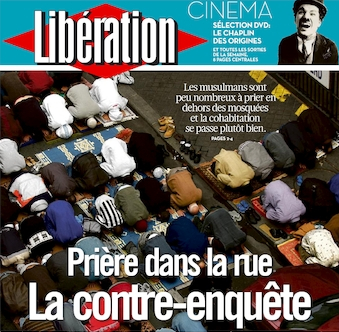
President Sarkozy has invited Abderrahmane Dahmane – President of the not-very-representative association, the Council of Democratic Muslims of France – to be his ‘advisor’ on the unpopular practice of praying to Mecca in the streets. The shortage of mosques means that it is not unusual in certain areas of northern Paris on a Friday afternoon, to see a street lined with kneeling men, their discarded shoes, lying neatly in the gutter behind them. In raising this issue again, only weeks after Marine Le Pen publicly compared Muslims praying in the streets to the Nazi Occupation, Sarkozy is once again pandering to the extreme right.

Recession tends to bring out this uglier side of French politics. For that is what anti-Muslim prejudice is in France – an ugly political consensus which frequently uses Marine Le Pen’s extremist outbursts as a cache-sexe for its own intractable bigotry.

The heady whiff of the street.

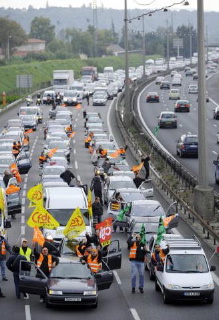
Once again and for the sixth time since my two boys went back to school in September, there is a general strike, a day of “interprofessional mobilisation.” Today, however, both of my sons’ teachers have decided to work. It would not be seemly for me to ask them why, but I suspect the reason is not that they’re against the strike, but that they believe the day of action will have sufficient impact without their participation. With over a million people taking to the streets, truck drivers blockading the roads, railway workers occupying the tracks, workers barricading the refineries and blocking the airports, both teachers may well feel that they can keep our little village school open without undermining the formidable tsunami of protest that makes France both the envy and the laughing stock of the world.

I know that the prevailing view outside this country is that these strikes are absurd manifestations of French petulance and immaturity. Expecting to retire at 60? What planet do the French inhabit? And how wise is it to paralyse the nation, further threatening its struggling economy for the sake of a privilege that is doomed anyway?

The feeling here is that this is not just about the retirement age but about the future of politics in this country, a notion that may seem a little absurd to those of us who believe that the age of political engagement is dead and gone. It is part of the French paradox that politics are still defined, for better or worse, by the interaction, or rather the collision between authority and rebellion. However sensible our parliamentary democratic traditions and our well-reasoned mistrust of the mob, the French don’t want to give up their revolutionary prerogative. The spirit of revolt in this country may be besmirched by violent episodes like The Terror but it is still the stuff that French dreams are made of, and this, I think, explains the massive support for these strikes.

Even those French men and women sitting in their offices in Paris, behind their spreadsheets, watching the marching hoards on their i-phones are susceptible to the thrill that goes with disobedience. And although they may have voted for him three years ago, they’re starting to feel the threat posed by Sarkozy’s style of governance to the political modus operandi of this country. They’re used to the dubious pleasure of seeing the power of the street weighing in key decisions and they, like many who support the strikers, are doing so with their hearts rather than their heads.

Good Things

I wish I didn’t but I do. I find Britain hard work these days.

I went to London last week to promote the release of my book in paperback. Here is a small vignette from my journey:

Nimes airport. A car park within sight of the departures hall. A walkway lined with lavender. The hiss off sliding doors. A cool, spacious interior. No shops. One or two adverts, pleasing to the eye. Nothing to buy. Only a little cafe, selling good coffee, croissants, pains au chocolat and simple, honest sandwiches.

I amble through customs. My hand luggage raises some suspicion and must be opened. A woman in uniform, polite and efficient asks me if I mind. Inside she finds a jar of local honey, some fig jam, some green olive tapenade and some goat’s cheese. All presents for my hosts in London. She gives me a rueful look.

“You’re not really allowed these.”

I sort of know this and feel a bit guilty and I make a face which says as much.

She packs up my things and says,

“Try to remember next time.” Then she adds, “If you grill that goat’s cheese with some of that chestnut honey and some walnuts…” She kisses her fingertips.

I smile at her.

“I know. I live in the Cevennes.”

She swipes her hand at me.

“Well then you know all about good things (les bonnes choses).”

And she zips up my suitcase.

I probably don’t need to recount the return journey from Luton. I’m sure you can imagine it:

Shops…Hundreds and hundreds of them. Clamouring at you. All of them part of the chains that wrap themselves round and round the British Isles and make every town and every airport look the same.

Then the long long snake through security. The detached, officious intransigence of the airport staff. We’re cattle and they’re rangers. Only I suspect rangers have more feeling for their charges.

A growth industry is here. Tiny ziplock bags to ward off our attackers. Cases gutted. People in various stages of undress; shoeless, beltless, humbled…

I reach the gate after a fifteen minute walk involving many stairs. The plane is due to leave in a further 15 minutes. It sits with its doors open on the tarmac in front of us. “I’m sorry madame… (No one has ever been less sorry) Gate’s closed.”

One of my fellow passengers is a Frenchwoman. She throws out an arm:

“But the plane is there! And we have another 15 minutes!”

“I’m sorry madam.”

I lead the woman away, telling her how pointless it is to protest.

We sit together on the bus to Stansted where the same labyrinth awaits us and she tells me all the things that she loves about living in Britain, which fills me with an unfathomable sense of pride.

French football hits rock bottom

To the outside world, the behaviour of the French football team in South Africa was shocking, outrageous, unfathomable… Anelka’s outburst, the team’s strike, Domenech’s toe-curling indecision – all of it has contributed to the vision of France as a broken society, prone to infantilism and mindless rebellion; a nation whose once glorious revolutionary heritage is turned to ashes.

There’s also, understandably perhaps, a certain pleasure, discernible in the British press in particular, at the unfolding moral decline of French football. What these commentators don’t seem to understand is that their schadenfreude can never match the special kind of pleasure the French feel when they experience failure. Because, despite what so many Englishmen believe, the French are hardwired for failure in a way that we British are not and so when the fall comes, as they know it inevitably will, their philosophers rush to the recording studio to put their heads in their hands and together, with the whole nation, they utter the cathartic mantra: through our fault, our fault, through our most grievous fault…

For the French this is not just the story of a bunch of spoiled, overpaid yobs behaving badly abroad. This is tragedy, played out on a national scale. And the story doesn’t begin in South Africa with Nicolas Anelka’s defiance, or even, as many have suggested, with Thierry Henry’s handball, the foul which sent an already guilt-laden France into this World Cup. Like all good tragedies the hubris was there, embedded in the glory days. The moral decline everyone is decrying was set in motion by this dynasty’s all-time hero, Zinedine Zidane. For surely it was Zizou’s momentary loss of control, the shocking headbutt delivered to Materazzi in the last World Cup final that led to the fall. In that moment all the rigour and precision and grandeur began to leak out of the French game.

Luckily the French are wedded to the tragic view, so they not only knew where it would end, but felt relieved when the end came and they could all chant their Mea Culpas and thus cleansed, start afresh.

You’ll take the high road and I’ll take the low road…

This is where I live. As you can imagine, it’s a place that deposits little hooks in your heart. You go away and they snag.

Soon I’ll be back.

Landscapes exercise a strange power over you. As if each of us has an internal landscape, embedded in us during childhood and which lies in wait until the point of recognition. Ah, there it is, you think. Or rather, there I am.

Gender War Fails to Make Good TV

The other night I watched the second part of a three part BBC documentary by someone called Vanessa Engle about the legacy of feminism on sexual politics in the UK. The one I missed, “Libbers” was about the pioneers of the women’s movement. The one I watched was about mothers today and the purported goal was to assess the effects of the feminist revolution on their daily lives – “to discover whether feminism has had an impact on gender roles in the family and the division of labour in the home.”

I urge you to watch it. For me the experience was excruciating. Engle’s approach was to interview married couples in their home and, as I saw it, attempt to mortify the man on the subject of housework. The couples varied as to the division of labour. Some of the mothers worked, others had chosen to stay at home with their children. Some of the fathers did no housework, others did some of it and one did it all. It was clear that none of the women interviewed felt oppressed and yet Engle seemed to be urging them towards rebellion, preferably in front of the camera. Unfortunately for her perhaps, the women were all clearly balanced and mature. Their lives were driven by choice, temperament, inclination. As far as I was concerned the film proved nothing other than the filmmaker’s belligerence towards the opposite sex and her somewhat regressive fixation with gender roles.

A typical line of questioning:

Engle: Would you say, Charles, that the two of you have an equal relationship?

Charles: Yes (Charles is the breadwinner)

Engle: Who does the laundry, Charles? (Cutaway shot of Diane looking embarrassed for him)

Charles: Diane.

Engle: And who does the cleaning?

Charles: Diane.

Engle: So Charles, if you have a bath do you clean it when you get out?

Charles: No.

What ensues is a seemingly interminable interrogation about bath cleaning in which Charles tries to respond calmly and honestly to Engle’s attempt to demonstrate that he is a) lazy, b) presumptuous and c) dirty, while Diane – an Oxford graduate who explains her decision not to pursue her career with the simple point that motherhood happens to fulfill her – tries to defend her husband against what begins to resemble a scene from Mao’s Cultural Revolution.

What is heartening about the film is the extent to which these couples seem to love and respect each other despite the barrage of ideology that is hurled at them. What is revealing about it is not the subject matter itself but the pernicious and intruding gaze of British TV.

The Secret Garden: the beginning of the end…

About six weeks ago I had an email from a Canadian journalist friend, based in Paris, asking me if I’d heard: Nicolas and Carla had separated. Even though I now live far, far away from the Parisian chattering classes, I had indeed heard the rumour. I was not very surprised or very interested and I did not take up my friend’s suggestion to blog about it.

Yesterday, though, I received three phone calls from British journalists (The Mail, The Express and The Telegraph) asking me to comment on the news. Their fascination did not surprise me, nor did the fact that Carla and Nicolas were already having affairs (they have never hidden their roving, predatory natures from anyone, least of all each other). What did surprise me was that the story had broken in France.

What is new and interesting about it all is the breach of French journalistic protocol that led to disclosure. In choosing to relay the rumour, albeit on one of its blogs as opposed to on its pages, the Journal du Dimanche was, for the first time, braving presidential wrath and potential ostracism by violating a sacred realm: Le Jardin Secret.

Lest we forget: for almost two decades Paris eagerly discussed the story of Mitterrand’s mistress, Anne Pingeot and their ‘secret’ love chid, Mazarine but nobody ever reported on it: not, that is, until the President finally gave the go-ahead and invited Paris Match in to photograph his beautiful and accomplished daughter.

It has long been a fundamental principle in France that a person’s private life, even a public person’s private life, should not become news. It is one thing for France’s celebrity magazines to stoop to Anglo-Saxon sensationalism but Le Journal du Dimanche…Is this is le debut de la fin?

Hiatus

Please forgive me for not posting over the next few weeks. I shall be in the bosom of that miraculous nebula that is the French healthcare service but hope to return to work soon.

I would like to thank everyone who visits this blog, for their readership and/or comments and their participation in a conversation about France and Britain that has so far been fascinating to me.

A tres bientot.

Lucy

Sacrées Françaises

BB

I had a call the other night from Jon Henley of The Guardian, who had reviewed my book and wanted to talk about a piece he was writing about French women. It seems there has been a sudden onslaught of books on the subject, some of them written by Anglo-Saxon women driven by the question: what do they have that we don’t? And some of them by French women driven by the desire to tell us. Among the authors are Debra Ollivier, American author of ‘What French Women Know‘ and  Mireille Guiliano, the former executive turned lifestyle guru, who brought us ‘French Women Don’t get Fat‘.

Henley and I spoke for about an hour on the subject, covering the differences between catholic and protestant cultures when it comes to attitudes towards beauty and love, as well as the differing attitudes towards feminism and gender in Britain and France. Towards the end he asked me what I thought the key differences might be between French and British women – clearly an impossible question but one I still rashly attempted to answer.

I don’t think French women ever took on the patriarchy, not in its symbolic form anyway and that – for the continuing survival of the pleasure prnciple – they have accepted a certain level of symbolic domination by men. Back in the late sixties, as the feminist revolution swept through France, it was as if there was an unwritten agreement to leave the private roles that men and women played untouched by the new movement. French women would fight with the best of us for social and political equality but the feminist revolution, it was tacitly understood, would not enter the private sphere, or indeed the bedroom. As a result, French women, unlike British women, still feel completely unembarrassed about playing ‘traditional’ feminine roles: domestic goddess, temptress, petulant princess or (when necessary or possible) femme fatale. British women, on the other hand, feel they have to behave properly, that they have to earn men’s respect. French women feel that they play by different rules to men and therefore have little interest in earning their respect; what they’re after is their desire.

France – Iran, a fusional relationship.

In two days time, six-power talks on Iran and its putative military nuclear programme are to be held in Germany, so I thought a little background to this show of international indignation might not go amiss…

In 1974, in the midst of the cold war, America gave France permission to provide Iran, whose northern border was unprotected from a possible Soviet missile attack, with enriched, weapons-grade uranium. Eurodif (European Gaseous Diffusion Uranium Enrichment Consortium), founded in 1973 by French industrialist, Georges Besse, still produces 25% of the world’s used enriched uranium. In 1975 Sweden, one of the five founding countries, withdrew from Eurodif and France agreed to offer Sweden’s 10% share to Iran. The Shah, Reza Pahlavi contributed an initial one billion dollars and then two years later a further 180 million dollars towards the cost of building the consortium’s uranium enrichment plant, in exchange for which his nation was granted the right to buy up to 10% of its precious output.

When the Iranian Revolution brought the Mullahs to power in February, 1979, two months before the Eurodif plant was due to begin production, France no longer felt inclined to honour the contract. Ayatollah Khomeini cancelled the Shah’s nuclear power programme due to lack of funds but reiterated his country’s claim to 10% of Eurodif’s enriched uranium output. When Mitterrand came to power in 1981, he continued to ignore Iran’s claim and so the regime in Teheran decided to use coercion. For ten years France was repeatedly targeted by Iranian-backed terrorism both on her soil and abroad. In an attempt to keep France’s conflict with Iran out of the news, most of the attacks, carried out by Hezbollah, were attributed to the western world’s bogeyman at the time, Libyan leader Muammar Gaddafi.

Eight French hostages taken by Hezbollah in Beirut and a series of bomb attacks in Paris finally put an end to France’s reluctance to honour the Eurodif contract and on December 29, 1991 Mitterrand terminated this secret war and signed an agreement re-establishing Iran’s rights to her 10% of weapons-grade uranium. France also refunded Iran over 1.6 billion dollars.

Main sources: Yves Bonnet’s “Nucleaire Iranien: Une Hypocrisie Internationale” and Dominique Lorentz’s “Une Guerre.”