The philosophizing chef

April is a big month for French academe. In April the nation’s aspiring intellectual elite sits the vertiginously difficult exam known as the agrégation. If they pass they become an agrégé, one of an illustrious cast of teachers at Lycee or University level that are guaranteed glory, prestige and a job for life within that 2 million-strong bastion of Republican orthodoxy known as l’Education Nationale.

My own son, in his fifth year reading philosophy at the Sorbonne, once described the agrégation to me in these terms: “If you pass, you’re basically set for life. You never have to prove yourself again.” I then set about trying to encourage him to reconsider the merits of such an honour and the effects it might have on his own imagination. I am pleased to announce, years later, that he no longer wishes to fight, along with several thousand other philosophy graduates, for the 30 or so teaching posts available to the agrégés but intends to leave with a simple Masters degree and become a cook.

Had he not changed his mind, he might have been one of the fifty or so unfortunate souls who set out last week – after a year of light, sleep and life deprivation – to sit the exam in a close suburb of Paris and were held up by a prolonged power cut at the Gare du Nord. These candidates, having arrived shortly after the doors had been closed, were declared ineligible by the education minister, Xavier Darcos and will simply have to try again next year.

Sarkozy’s plans to scrap the exam and replace it with rather less elitist qualifications that include a Professional Masters, have of course met with widespread outrage. The French blogosphere is awash with lamentation. Detractors of the reform predict “the collapse of general knowledge and culture,” and blame “a spirit of ubiquitous capitalism” which turns human beings into “automatons” driven, not by “personal enrichment” but (Heaven forbid) by “work.”

Romantic Regime

“Without sexual liberation we could not have written this book , and yet we wrote it in order to shield love from the discourse of (political) liberation. For what is desire but the experience of a wonderful subjection?”

“‘Sans la libération sexuelle nous n’aurions pas pu écrire ce livre, et pourtant nous l’avons écrit pour soustraire l’amour à l’emprise du discours de la libération. Qu’est-ce en effet que le désir amoureux sinon l’expérience d’une sujétion merveilleuse ?”

Alain Finkielkraut, one of France’s (more controversial) contemporary thinkers, in the Nouvel Observateur, March 2008.

The Politics of Beauty

Carribean beauty and maths genius, Christine Kelly

Caribbean beauty and maths genius, Christine Kelly

Once again the British media has been caught drooling over French political eye-candy and lamenting the general homeliness of our own parliamentary matrons. This time it was 39 year-old, Christine Kelly, former journalist and head of the CSA (France’s broadcasting watchdog) who was rumoured to be replacing Justice Minister, Rachida Dati – another hottie in Sarkozy’s cabinet. ‘Knockout Lovely’ or ‘Oh Yes, Minister!’ went the British headlines. As it turned out, the rumour was unfounded and Angelique Chrisafis wrote a very good piece in The Guardian, deriding the tabloids for their Benny Hill puerility and offering a short lesson on French gender politics. “The British hopelessly misunderstand French gender politics,” Chrisafis argued. This was not about Sarkozy “assembling a chorus line of glamorous women” but about effective political symbolism in a nation where only 14% of MPs are women (20% in the UK): “Sarkozy has done more than any other French president to appoint women to serious positions in cabinet.”

Chrisafis is right: Sarkozy is indeed advancing the cause of women and his choices are not conditioned by his machismo. But that is not the key to this little vignette of Anglo-French misconstruction. The main point is that French men and women are allowed to look glamorous. They have permission to aspire to beauty. In our (Protestant) culture, where appearances are to be mistrusted, we are not, and if we do, we are made to feel a little guilty about it. Hence the total bemusement in France every time the British press gets into a frenzy about unabashed feminine beauty. (Remember the fantastic Sun headline “Mrs. Starkerzy Arrives in Britain” ?) In French culture beauty is just another attribute to be prized and enjoyed. Perhaps we need to calm down a little and ask ourselves if it’s time to examine the legacy of guilt which surrounds both beauty and sexuality in our culture.

French ethnicity, a contradiction in terms?

photo by raphael Labbe

Beauty and Genius are a big help to integration in France

The controversy rages on about whether or not France should start openly gathering statistics about her ethnic minorities. (My guess is that it is one of those national distractions that must come as a boon to our sex dwarf.) It is also a completely ridiculous and hypocritical debate (see previous post). Surely the question is this: instead of eternally stigmatizing individuals born in France with the migration of their parents, why not come clean and ask them their ethnic origins? In this way, France can at last offer the possibility for these citizens (whose parents may have been born Algerian or Senegalese) to claim an extra layer of selfhood? There is a serious gap in this culture between the ideal of ‘ethno-solidarity’ (sustained by the universalism inscribed in French law) and the rather more pressing need to reduce very real inequalities. The fact is that if you’re French and Black or Muslim you’d better be either Zinedine Zidane or Patrick Viera because France’s natural intolerance towards mediocrity becomes particularly ferocious when it comes to her minorities.

The Equality Myth

Here’s  the thing. France is the land of human rights. Not to mention Equality. It is therefore illegal here to gather data on the basis of a person’s race or ethnicity. How, then, without statistics to enable analysis, does she address the very real problem of discrimination in her society? This very sensible question has only recently been taken seriously here. Why? Because Sarkozy, in thrall to the Anglo-Saxon social model, has set up a new commission, headed by a businessman of Algerian origin called Yazid Sabeg, in order to measure and promote ‘diversity’. The English-speaking world is busy applauding on the sidelines while most French intellectuals on both left and right band together in fierce opposition. What are these guardians of the republican model afraid of?

Three things:

1) The Past: the last time the citizens of this nation were invited to provide information on the basis of their racial origins was under Vichy’s ruthlessly efficient anti-Semitic regime.

2) The Present: if France gives in to this initiative and starts openly gathering data on her ethnic minorities, she will have to face the reality of how truly elitist and non-egalitarian her society actually is. (There is basically no black middle class in this country.)

3) The Future: If France allows herself to debunk the myth of equality by acknowledging the day to day reality of her immigrant populations she will have to do something about it, maybe even start considering such terrifying proposals as affirmative action. Should this happen, it will only be a matter of time before her highly elitist National Education system and with it, all the vestiges of her aristocratic traditions that have survived so well since her revolution, crumble and die.

I’m not too worried, though. Sarkozy’s measures so far are only posturing. France has plenty of data about her immigrant communities. To get around the law she simply asks, Where were you born, where were your parents born, and your grandparents? She already has all the stats on her first, second and third immigrant generations. She simply doesn’t want to wash her dirty laundry in public. Is that too much to ask?

On Liberté

The PS Cries Freedom

The PS Cries Freedom

The French Socialist Party (PS), in an attempt to claw back some attention, respectability and perhaps even a little grandeur, recently organised a rally in Paris called (impressively) “The Spring of Freedom“. Chaired by the First Secretary of the PS, Martine Aubry (Photo:Left) the meeting followed Ségolène Royal‘s equally grandiose “Rally for Fraternity“, which was held last September. This time, though, it seems that, in the face of the rather dingy realities of today’s economic climate, the abstract noun – usually so effective in drawing French crowds – is losing some of its magic. Only about 1500 militants showed up in a venue built to house twice that.

Liberté, égalité, fraternité or (lest we forget) Death.

Liberty, Equality, Fraternity...Or Death

Liberty, Equality, Fraternity, Or Death

Working its way through the potent nouns that make up this country’s national motto – indeed, its very identity – the PS is attempting to lay claim to France’s revolutionary heritage and at the same time, draw the political discourse away from the pragmatics of the economy and towards more abstract territory, where it feels safer.

“Our struggle,” Aubry announced yesterday. “Is to make sure that equality and liberty go together.” («Faire rimer égalité et liberté, c’est cela notre combat») To help enlighten those who may be baffled by the intangibility of this objective, the PS recently published a book entitled, “La France en Libertés Surveillées” (“France: Liberty Under Surveillance), which condemns the Sarkozy government’s perceived attacks on civil liberties, within the domains of parliament, the police, the judiciary, immigration and the media.

Those looking for some hard facts may be a little disappointed by this 166 page document. The opening sentence, a quote from Montesquieu‘s “L’ Esprit des Lois” (The Spirit of Laws)  sets the tone: “To prevent the abuse of power ’tis necessary that by the very disposition of things, power should be a check to power.” («Pour qu’on ne puisse abuser du pouvoir, il faut que, par la disposition des choses, le pouvoir arrête le pouvoir.») Ségolène Royal, who is quick to point out in her blog that she did not help to write this pamphlet, admits that the freedoms in question “are still there but…they are slowly being taken over (“mise sous tutelle”).

What emerges from all this is not so much a conflict of policy but of philosophy. We are seeing here the opposition between two notions of freedom, one being pushed by Sarkozy and his like and the other being defended by his detractors. In his work “Two Concepts of LibertyIsiah Berlin defined these opposing notions as “positive” and “negative” liberty. Put simply, the idea of positive liberty is the possibility for an individual to attain the goal that he/she has set or to pursue his/her desires unhindered. In this view of the world, the individual is empowered and liberty is a form of power. The other concept of freedom is the provision of a space in which the individual may thrive without being bothered by others. It is simply the absence of coercion or molestation. France has a long and entrenched attachment (which predates the Revolution) to the idea of positive liberty, while in the Anglo-Saxon world we champion the rather less glamorous version. Paradoxically, it was an eighteenth century Frenchman who best formulated the differences between the two: “The free man is the man who is not in irons, nor imprisoned in a gaol, nor terrorized like a slave by the fear of punishment … it is not lack of freedom not to fly like an eagle or swim like a whale.” Claude Adrien Helvétius.

So it is that when his enemies refer to our Sex Dwarf as “Sarko the American”, they are not only alluding to his shameless materialism and his philistinism, but also to his dangerous susceptibility to the Anglo-Saxon vision of what it means to be free.


Reve General

I strike therefore I am

Non, non et non.

France by Numbers

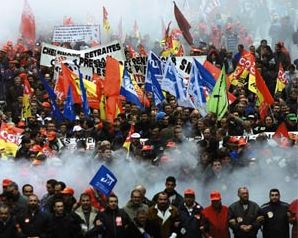
78… % of French people back today’s strike (according to an IFOP poll).

8… trade unions are calling for the strike (the CGT, the CFDT, FO, CFE-CFC, CFTC, Solidaires, FSU and Unsa).

219… demonstrations across the country attended by…

1,08 million… demonstrators, according to police estimates and…

2,5 million… demonstrators, according to the unions.

14,100… jobs to be cut in research and education as part of Sarkozy’s proposed government spending reforms.

300 – 400 million… euros is the estimated cost of a strike day like today’s, according to Finance Minister, Christine Lagarde.

2.6 billion… euros: the cost of the package secured by the unions from Sarkozy after the last general strike on 29th January.

The Address of Shame

Former headquarters of the French arm of the Gestapo

Former headquarters of the French arm of the Gestapo. Known as 'La Carlingue' (cabin) the address also served as a brothel.

93 rue Lauriston, 75016, Paris, is an address known to most of France (at least those vaguely aware of her history) as the headquarters of the French Gestapo from 1941 – 1944. It is not, it would seem (however expensive the real estate in this particular part of Paris) an address that is desirable to its potential tenant, former Foreign Minister to Chirac, Monsieur Herve de Charette. The MP recently asked Claude Goasguen, the good mayor of the sixteenth arrondissement (by far the Nazi’s favourite quartier), to ask his council members if they could possibly change the address…From No. 93 to No. 91a, rue Lauriston!

“The past associated with the address was embarrassing to me,” the former minister has since explained, by way of justification. “Particularly since I’m responsible for a Franco-Arab* organisation. My request was well-intentioned: to get rid of the address of shame. I didn’t know I was going to trigger all this controversy.”

Obligingly, Mayor Goasguen (a fellow member of Sarkozy’s UMP party) put it to the vote. Significantly, 8 out of his 12 councillors abstained but no one dared to vote against his motion, which was quite simply absurd. Not revisionist, as some have claimed, not fascist, but plain mad.

The mayor, who has rather clumsily described his position on the subject as “neither for nor against”, has since dropped the matter. (The matter, though, has not dropped him.)

It all reminds me of the suggestion, made a few years ago, by the MP Gérard Charasse, that a law be passed to prohibit any assimilation of the Vichy regime with the town of Vichy (one of the key towns in his constituency). Article 4 of his law (which thankfully has never seen the light of day) states that “Shall be considered an imputation causing prejudice to the honour and reputation (of Vichy)…any designation tending to assimilate the name of the town or its inhabitants with treasonous behaviour, capitulation, or offense to republican values.”

When will this country ever recover enough from the trauma of the Occupation to stop wanting to forget it?

*President of the Franco-Arab Chamber of Commerce.

Sarko, L’Americain

Clemenceau, a proto anti-American

Clemenceau, a proto anti-American

France is back in NATO. Why does it matter that more than four decades after de Gaulle slammed the door, Nicolas Sarkozy is to bring France back into the Alliance’s integrated command? The gesture – for it is more potent as a gesture than as an action – is Sarko’s most radical move to date. Not because it will change much on the ground: France is the fourth largest provider of troops to NATO and has led NATO missions to Kossovo and Afghanistan but because,

a) it will put an end to decades of hypocrisy: all through the nineties, French foreign policy required that any arrangement which put French forces at the disposal of NATO, had to be agreed in secret (Daniel Vernet, Le Monde 24/6/08)

b) it undermines the sacred cow of anti-Americanism and thereby strikes at the heart of the nation’s identity.

Because despising the Americans – for their materialism, their consumerism and their perceived philistinism, in short for their quintessentially un-French value system – has been an acceptable national pastime ever since May ’68. And even before that, as far back as the First World War, the French ruling classes, who were learning to resent the emerging superpower, felt entitled to the kind of savage remarks made by Georges Clemenceau (who happened to be married to an American):

‘America is the only nation in history which miraculously has gone directly from barbarism to degeneration without the usual interval of civilisation.’

Feminine…In my mind…

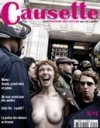
a new women's magazine Here is the first issue of France’s brand new women’s magazine: ‘Causette’, or chatter (dangerously homonymous with Victor Hugo’s eternal victim, Cosette?) No, announces the editorial: “Just a bit of enriching chatter with a healthy dose of humility and quite a lot of irony (mordant)”.  Hmm. And inside, a beauty contest for homeless women in Belgium, France’s new hot, black actor, Jacky Ido (in the nude), a bit of literature and a spot of fashion. ‘Causette’, we are told, is “feminine in the brain” – meaning what exactly? Doesn’t matter. I’m loving it. Especially if we’re spared the psycho-analytic twaddle, pioneered by Elle and common to most women’s magazines in France, which all seem to have their resident Freudian analyst, answering all your woes from sporadic orgasm, to coping with your child, to dealing with your lover…

Vive La Femme!

Yesterday (Sunday, March 8th) was International Women’s Day (IWD)

I can’t help smiling at the differences between the French woman’s celebration of this global event and that of their Anglo-Saxon sisters. You only have to look at the two websites devoted to the IWD in French and in English, to spot the huge disparity in tone, ethos and conception.

Started in 1911 by Clara Zetkin, the German Socialist and Women’s Rights campaigner (confidante of Rosa Luxemburg) the idea of the IWD was to set aside a day every year – in any country that was at all interested in the idea of women’s rights – in which to celebrate women and provide a platform on which to press for their demands.

Today, the IWDs English web page claims to celebrate “the economic, political and social achievements of women past, present and future”. The French home page, on the other hand, is a shamelessly sentimental jamboree celebrating a rather quaint idea of femininity. It features an open letter, written by one of this year’s participants in the Journee de la Femme (JDF)  2009  Beaux Texte (Beautiful Prose) Competition. The entry is a “message in a bottle” tossed into the “tempest” that is the fight for female equality.

The text begins like this: “Will this world one day unite in its masculine and feminine sides? For what is there that is more magnificent than the mystery of the meeting of a man and a woman?” Est-ce qu’il sera un jour ce monde uni dans son masculin et son féminin ? Car qu’y a-t-il de plus grandiose que le mystère de la rencontre d’un homme et d’une femme ?

And ends like this: “A reunion through the fusion of souls, the explosion of bodies in the hope of the redeeming flowering, through the conception of a child, daughter and son alike, who will bring with them the best (of all possible worlds).” Réunion dans une fusion de leur âme, dans l’explosion de leur corps avec l’espoir d’une éclosion rédemptrice dans la conception d’un enfant , fille ou fils tout confondu, porteur du meilleur.

I could not hope to find a better illustration of French idealism v. Anglo Saxon pragmatism than these two readings of the IWD and the JDF.

In mitigation…Here is a a popular song called Je Suis Une Femme (I am a Woman), written to celebrate this year’s JDF by the two very gifted – and mercifully ironic – French loons, Clément Marchand and Alexandre Castagnetti.

The Meaning of Sarkozy

…Both Blair and Sarkozy are lawyers. Both are precocious and imbued with an unwavering self-belief. Sarkozy, however, is French, which means that he is burdened with a sense of history that would be unimaginable to Blair. Despite the voluntarism of his campaign, Sarkozy has learned, through a painful confrontation with reality, that both he and his politics are circumscribed by the landmark moments in his nation’s past (the Revolution, The Occupation, May ’68). As any right wing politician would have told him, it was vain of him to hope that by the sheer force of his will and his rhetoric, he could drag France away from the founding myths that still define her and make her (emotionally at least) left-wing.

A review of Alain Badiou’s book on the Sex Dwarf

Reality catches up with Loana

LoanaLast night the young woman whom all of France knows as Loana was found unconscious in her bathroom and rushed to hospital.

Loanna Petrucciani, a 31 year old ex-stripper from Nice, with the body of a sex-goddess and the eyes of a young goat, was rocketed to instant fame for being the winner of France’s first reality TV show. The French version of Big Brother was renamed ‘Loft Story’ in a bid to eliminate those dark, dystopian connotations and give the programme the classy overtones essential to the French masses. For by April 2001 when Loft Story was first aired, to live in un Loft was the ultimate in chic.

Loft Story logoThe first group of 12 ‘Lofteurs’ as the contestants came to be known, included Loana, the leggy blonde with a slightly she-male beauty (above) and Steevy Boulay (both went on to become famous). Steevy and Loana were born in that era when it was de rigeur to name your child after a character in the hugely popular American soaps that were invading France, like ‘Bay Watch’ (Alerte a Malibu) or ‘The Young and the Restless’ (Les Feux de l’Amour). Hence the explosion in the seventies and eighties – to the chagrin of those state officials at your local mairie (town hall) whose job it had always been to make sure that your baby’s intended name figured on their list of Catholic saints – of Anglo-Saxon abominations like Kevin, Trevor, Jordan, Jessica, Steevy and Loana.

I remember being glued to Loft Story with my teenage children when it first came out. It seemed to capture modern France like nothing else on television. We watched in horror as the French public showed its true colours and eliminated, first the Arab (Aziz), then the only person of mixed race on the programme (Kenza) and then the homosexual. (Steevy took five years to actually come out. He waited until he had become a successful television presenter before confessing that he was Catholic, Right wing, ecstatically pro-Sarkozy and Gay – which of course no one had doubted for a moment.)

French reality TV, when it arrived, revealed just what a poor opinion the French have of reality. In this country steeped in idealism, reality is something to be avoided at all costs. As a result Loft Story and all the versions that have come since are, compared to their Anglo-Saxon equivalents, shamelessly polished, choreographed and filled with histrionics. The contestants tend to be beautiful all the time and behave in front of the cameras with the woodenness of dubbed American soap actors.

Loana’s life, the doctor’s say, is not in danger.

Here, for your delight, is a video of Loana’s memorable pop song, “Comme je t’aime’

The French Strike Again (Bless them).

I strike therefore I am.

The French love nothing more than to strike. Even if they don’t actually approve of the cause of the strike, watching their country grind to a halt puts them in touch with their visceral, ancestral selves and makes them feel alive. And who can blame them? Strikes in France are fun. People become uncharacteristically friendly during periods of social unrest. They give each other lifts, talk to each other in bus queues. Against all reason, men and women from every social milieu feel impelled to rally behind the deep, instinctual cry of the protesting toddler in the face of authority: “Non, non, non, non, non!” This explains why, at a time of severe economic crisis for their nation, 69% of French people support today’s general strike (Le Figaro).

President of Sud Rail, France's second railway union, confirmed on French radio that "basically we're practicing class warfare."

The President of 'Sud Rail', France's second railway union, confirmed on French radio that "basically, we're practicing class warfare."

Fighting Talk

“The law is the law,” the French Minister for Education, Xavier Darcos, announced bravely last October. “It (a law to ensure a minimum service for the public sector during a strike) has been voted and validated by the Supreme Court. It must be enforced,” he thundered.

Today, in spite of Xavier Darcos’ promise to provide a minimum service in primary schools, my son’s school is closed. (He is next door shooting his enemies with a very noisy phaser.) Today’s Le Parisien provides a long, long list (which includes Paris itself) of all the towns and cities that will not be respecting Darcos’ law.

Xavier Darcos is what the French call a faux dur (a fake toughie, or someone who pretends to be tough). The French political landscape is littered with the bodies of ‘faux durs’ who promised to push through unpopular reforms and caved in under pressure from the street.

Example of A Faux Dur

While Jacques Chirac was building his political persona, he sought, like most French right-wing politicians of his generation, to emulate de Gaulle’s authoritarian style and grandeur. He did not fool anyone for long, for it soon became clear that Chirac was a bon vivant* pretending to be a dur.

The Real Thing

That, perhaps, is why Margaret Thatcher was such a source of fascination to so many of them. François Mitterrand said of her, “She has the mouth of Marilyn Monroe and the eyes of Caligula,” and although he had difficulty disguising his contempt for her evident lack of culture, he could not help admiring her vision and determination. For politicians like him, Thatcher was the real thing, which may have explained Chirac’s exasperation when he murmured to an aide, during one of her state visits, “What more does that housewife want from me? My balls on a platter?”

* Not, as many English people believe, a bon viveur.

Something a Little More Lowbrow

Some Useful French Expressions

Elle pète plus haut que son cul
Literally: she farts higher than her bottom (She’s up herself)

Elle m’a posé un lapin
Literally: She left me a rabbit (She stood me up)

Elle est partie comme un pet sur une toile cirée
She left (as quickly) as a fart on tarpaulin

Là, tu encules des mouches.
Literally: You’re sodomising flies (Splitting hairs)

Avoir une taupe a la caisse
To have a mole at the check-out (to really want to do number twos)

Je l’ai eu le doigt dans le nez/cul
Literally: I got it (e.g. passed an exam) with my finger in my nose/bottom (i.e. very easily)